24th March 2026
Teacher of the Year Mr George Barrett on ‘just doing it’
Hello everybody,
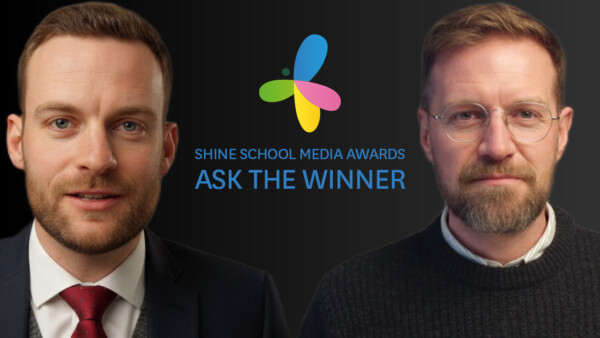
This week’s Ask the Winner is the last in this season. It’s also a little different! I’m talking to a winning teacher.
George Barrett teaches history at Ermysted’s Grammar School in Skipton and won the 2025 Most Inspirational Teacher award. Seven and a half years ago, he founded The Reason, the school newspaper that’s now produced National Geographic journalists, a Cambridge student newspaper editor and countless writers who learned their craft in his classroom.
His advice for teachers thinking about starting a school publication? “Just do it. Just take the plunge.”
Three seeds planted
When George arrived at Ermysted’s in 2018, there was no school newspaper. But he noticed things.
“I went along to the debating society and I was really impressed by how articulate the boys were and how passionate they were about a real range of topics – parliamentary reform, ethical matters, science.”
Then came the essays. “I started getting back quite a few essays from pupils. I was really quite impressed by the quality of the writing.”
The third seed: a Year 13 prefect sent an email to the whole sixth form saying “I want to set up a school magazine because I want my voice heard.”
“I thought actually this is quite an interesting idea. I’d been part of the student newspaper at university, so I approached the pupil then emailed the whole sixth form saying, ‘we’re having a meeting in my classroom at lunchtime’. I thought: we’ll see what happens.”
That first meeting was a success, setting the precedent for all that follows. An early decision was the name, based on the school’s motto: Suive la Raison (Follow Reason): the newspaper would be called The Reason.
An adaptable model
The newspaper has evolved over seven years depending on who’s in the team. An early model involved Editor, Deputy Editor, Managing Director (responsible for sales and advertising), then section editors for news, politics, economics, science, sport, creative arts.
“We tried to skill everybody up in both design and content creation. The editor had overall responsibility for content, the deputy editor had overall responsibility for design.”
“Our editor last year first got involved as a Year 7 and he’s the first person to become the Year 13 editor. We’ve now got this pipeline of pupils going through the school who have written for and edited The Reason over a number of years.”
George’s advice for sustainability: “If you’ve got this great group of students but they’re leaving at the end of the year, you need to work with your students to conjure up support from lower down the school.”
Moments of genius
Sometimes brilliant ideas come from submissions. “We had a pupil who submitted a piece on nanobots – purely inspired by himself. He wrote in and said, ‘I’m really interested in nanobots, I think I’ve got something interesting to say.’ Sometimes it completely comes out of the blue.”
Other times it’s from editorial meetings. One editor wanted something that reflected the local area. “A lot of our pupils come from farming communities. With the inheritance tax and various other things in the news about farming, one pupil said ‘I really want to write about this because I’ve noticed the impact on my community, my friends who’ve got farms.'”
“When pupils really try to relate a national issue to their everyday lived experience – those stories are really interesting. That’s where student journalism and the voice of a young person can really cut through.”
One editor flew a drone in an exam hall and used early AI to create a front page showing the disparity between exam results in the north and south. “This was before we had AI in everyday use – it was very impressive.”
Where they are now…?
One section editor from the first editorial team secured a Fulbright scholarship to study war journalism at NYU. “He’s now off in Antarctica doing reporting for National Geographic.”
Another early writer is now editor of the student newspaper at Cambridge. “He was one of the first writers back in Year 9, then went on to take a section editorship.”
“What we want to do as teachers is educate the next best citizens for the next generation. Once you get a newspaper where pupils are working together and bouncing ideas off each other in sometimes quite a feisty environment – that is a model for the workplace and future life.”
George’s final message: “If you’re a teacher, just do it.”
I hope this series has shown you that student journalism creates genuine opportunities – from launch events to newsroom visits, from local storytelling to national recognition.
Thank you for listening to Ask the Winner. I’ve loved bringing you these conversations.
Enter the 2026 Shine School Media Awards
– with our deadline coming up soon!
Could your school magazine, newspaper or podcast be this year’s winner? The Shine School Media Awards celebrate student journalism and school media projects that give young people a genuine voice.
Entry is open to all UK schools. Winners receive money-can’t-buy experiences including mentoring from industry professionals, newsroom visits and work experience opportunities.
Don’t forget, our deadline for entries is 1st May 2026.
Have a great Easter break,
Richard
Chair of Shine