7th October 2026
What a student editor wants from her teacher
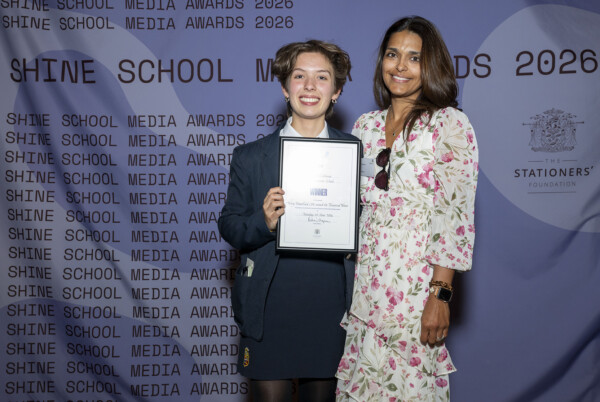
Back in June, student Annabel won the Terry Mansfield CBE Award for Tomorrow’s Talent at the 2026 Shine School Media Awards. Annabel had been involved with school magazines from the age of 14, joining a longstanding team at one school and (impressively!) starting a new publication from scratch at her next.
After her win, we asked Annabel what teachers can do to support student editorial teams working on newspapers, magazines and podcasts.
Here’s what she told us…
- Joining a magazine or starting one
Annabel has seen the project from both sides. Her first school already had a magazine, so the editorial team could iterate and improve it, year on year:
“There was a jumping off point for iteration: so, for instance if we liked how we did one part of the magazine last year but would quite like our own spin on a different part, then we could already have a springboard basically for the 3rd edition, even while we were making the 2nd one.”
- Starting a new magazine meant asking students to join something they couldn’t yet picture.
“It was very much a case of people trusting in me to create a magazine that was going to bring in their ideas, even when they didn’t know what it was going to look like.”
“When you’re joining a project, you already have that space. It’s just the creativity to add in. Without that, you need real creativity which we had at Ripon and created our own blank space and then showed people that they could apply their creativity within that.”
- Let pupils lead the editorial
At her first school, staff took care of paperwork, printing and entry forms. The students ran their own meetings and content.
“If the entire editorial side can be comfortably led by the pupils because they know that if something logistical needs to happen outside of that, it will be dealt with by teachers, that allows for the ultimate creative freedom in the project itself.”
- Recruit through the team you already have
“I think by really, really, really listening and coordinating with the pupils you already have, they can become the best point of reference for the project.”
Annabel sees a teacher’s role as the go-between who finds out what the team needs.
“Whether that’s having more artists or having different or more opinion writers, teachers can help fill the gaps in their personnel arsenal.”
“I don’t think that in many instances in schools, other than a project like a magazine, pupils get the agency to communicate these kinds of needs in such a clear and significant way.”
- When Annabel arrived at her new school with the idea for a magazine, her teachers’ first answer set the tone.
“My teachers said: ‘we don’t know about editing magazines, we’re not experts, but if you want to do this, we will support you’. And that was the most helpful thing they could have said.”
“They didn’t try to take over, they didn’t try to make it something that they thought the school wanted.”
“They did a lot of research into the logistical side of things such as printing and advertising when we were considering that. They set up meetings for me, they arranged assemblies for me. They did everything that I simply didn’t have the bandwidth to do while I was trying to put my entire soul into selling this creative project to the student body.”
- Make time for a weekly check-in: Annabel’s strongest piece of advice
“Setting a consistent time that you meet with the leaders of the project so that they feel supported and therefore they’re able to be more independent in leading the team.”
“I would have been far more hesitant about maybe taking large decisions editorially or in terms of the personnel that I had if I didn’t feel that I could go and see someone and explain: can you just clarify or validate my idea here before I pitch it to the entire team?”
- She knows what she is asking of busy staff.
“I know it is really difficult for staff in the modern education system. It’s so difficult to allocate that time when so much is asked of them.”
- Be part of the content
“I think staff are an amazing avenue for creating content, because I think a lot of them have so many fascinating academic interests of their own.”
“We had a couple of instances where some of our teachers with their own sort of independent interests were thinking, well, I know that this member of staff shares my interest on this, we’d be happy to if you wanted to conduct a form of interview or conversation about a topic with the two of us as a piece of content.”
- Ask what worked
After winning the Shine Awards, Annabel’s school sat down with her to learn from the year. They wanted to be ready to support the students taking over.
“They arranged a sit-down meeting with me and said, okay, this is what has happened. What do you feel we did right? What do you feel we could do better?”
With a little support from her teachers, our superstar student Annabel led her editorial team to success in this year’s competition.
If your school has a magazine, newspaper or podcast, or a student with an idea for one, register for the Shine School Media Awards. There’s no cost to enter and we can provide encouragement as well as online hints and tips to make their project even better.
Encourage your students to start a school media project or funnel groups of students with talent interests into one of these areas. Even better, you might find they already create school work that is eligible for the Shine School Media Awards via the AQA Level 3 EPQ (Extended Project Qualification) where, for instance, a student has led a completed and assessed media project.
We’d love your students to be part of the Shine School Media Awards next year. We’re accepting registrations for the 2027 competition right now, just tap on the link below.
Entry deadline: 7th May 2027
Do you have any questions? Email us direct at shine@stationers.org
Best wishes,
Richard Chapman
Chair, Shine School Media Awards